
As an author of gay fiction, I’m often pigeonholed by friends and family as writing Romance or Erotica. Yes, I did dabble in both of these genres briefly, but a majority of my work is Magic Realism. The other genre I’ve written is Dystopian.
In the US, there is a huge demand for gay romance, and as my publisher is American, I’m often mistaken by readers and bloggers as a Romance writer in that country. That is, until readers sample my work.
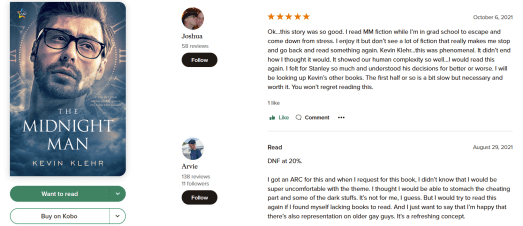
When my novel, The Midnight Man, was released, I went to great lengths to find the right reviewers. I was in Sydney lockdown, so I had a lot of time to consider marketing.
The book is an Urban Fantasy about a middle-aged man who finds the man of his dreams, literally in his dreams. But it really is about ageing. The main character, Stanley, feels like his best years are behind him. He sees himself as a failure. The plot includes his cheating partner, Francesco. Stanley is unaware of the affair. This is important as it’s one of the factors which eventually forces Stanley to ‘find’ himself.

Besides contacting many possible reviewers, I took the advice of a publicist who recommended a Gay Romance ARC management service. The conversion rate was hefty, but I added it to my marketing budget.
I had to follow them up as I only saw one review which I could accredit to them, and a lot was made of the cheating aspect of the story. They informed me of some short Goodreads, Amazon and BookBub reviews which they were also responsible for, but nothing other than one on a blog review site. They said they had little interest as there was a character who cheats in this novel.
This made me laugh. Cheating is an age-old plot device. How can the readers of this genre have issue with something that can heighten the tension in a story? Or heighten the tension, sexually. It would be like omitting a murder out of a thriller.
And how did we get to this point in the twenty-first century? I recall an episode of M*A*S*H where BJ fell into the arms of a woman one night, then writes to his wife confessing his one weak moment. Hawkeye stops him sending the letter, reasoning that being in a war zone is stressful, and the fact that this is the only time guilt-ridden BJ cheated, it’s not worth sacrificing a marriage for. Regardless of what you think of the ethics of this plot, my point is, this is primetime television 1970s style.
One of my favourite recent television dramas was Masters of Sex. It explores the far-reaching consequences an adulterous affair can have. Plus, it’s an interesting show from a historic perspective.
And I do recall Do Re Mi’s classic song, ‘Adultery’, making the top ten in the 80s.
Fortunately, The Midnight Man, has received a healthy number of good reviews. Cheating has not been mentioned. The themes of the piece have been the main focus.
Even the lovely woman who corresponded with me from the ARC management service pointed out that ‘the slightest hint of cheating in a book can be an instant and immediate no-fly zone for readers – to their detriment…’.
 kevin klehr